

- UPDATED !
Gas Leakage detector for flammable gases
-
- No field calibration
- No cross sensitivity
- Long lifetime 15+ years
- Fail safe (built-in diagnostic)
- Flammable gases concentration 0-100% LEL
- Built-in T and Rh compensation
- Immune to poisoning
- Operating range -40° to 70° C, 0-100% Rh
- Modbus, 2x Relays and 2x Analogue Output (ALL IN ONE)
Description

MLD series are unique smart refrigerant or flammable gas detectors used in HVAC-R applications as well as flammable gas leakages in industrial production sites. MLD Series is robust, extremely poisonresistant, factory-calibrated, with more than 15 years of lifetime expected without any recalibration process needed.
Flammable gases are widely used across a variety of industrial and commercial applications, including hydrogen systems, fuel cells, gas storage and distribution, and industrial processes. While these gases offer important advantages in terms of energy efficiency and performance, their flammability requires reliable detection systems to help protect people, equipment, and facilities.
Early detection of gas leaks is essential to prevent the accumulation of flammable gases and reduce the risk of fire or explosion. Gas detection systems must therefore provide reliable and continuous monitoring, even in demanding operating environments.
The MLD gas detector is designed to detect a wide range of flammable gases, providing a reliable solution for applications where safety is a critical requirement. Based on advanced sensing technology, MLD offers long-term stability and continuous monitoring with minimal maintenance, helping to ensure safe operation across a wide range of industrial applications.
The MLD series with NevadaNano’s Molecular Property Spectrometer™ (MPS™) Flammable Gas Sensors serves the needs of a wide range of industries with precise and dependable detection of most common flammable gases.
Currently the MLD Flammable is ideal to detect butane, ethane, hydrogen, isobutane, isobutylene, isopropanol, methane, methyl ethyl ketone, octane, pentane, propane, propylene, toluene, xylene but check with GVZ Components for the latest list of detectable gas.
-

A3 and Flammables
MLD Flammable Gas Detectors are engineered to provide precise and dependable detection of highly flammable gas used in a wide range of industrial applications.
-

Convenient Output Options
These sensors offer versatile output choices, such as a digital bus and configurable analog voltage output, ensuring a seamless and hassle-free integration process with your existing systems, catering to diverse requirements.
-

Tailored to Your Needs
The MLD flammable is the ideal safety solution in a wide range of application from Oil & Gas to BESS and mining, or in waste management where landfill gas and biogas monitoring for methane detection and emissions compliance is required.
.


Main Features
Our industrial detectors employ smart sensor technology, ensuring consistent high performance and reliability.
Utilizing smart sensor technology, the sensors provide the following features critical to manufacturers and end users:

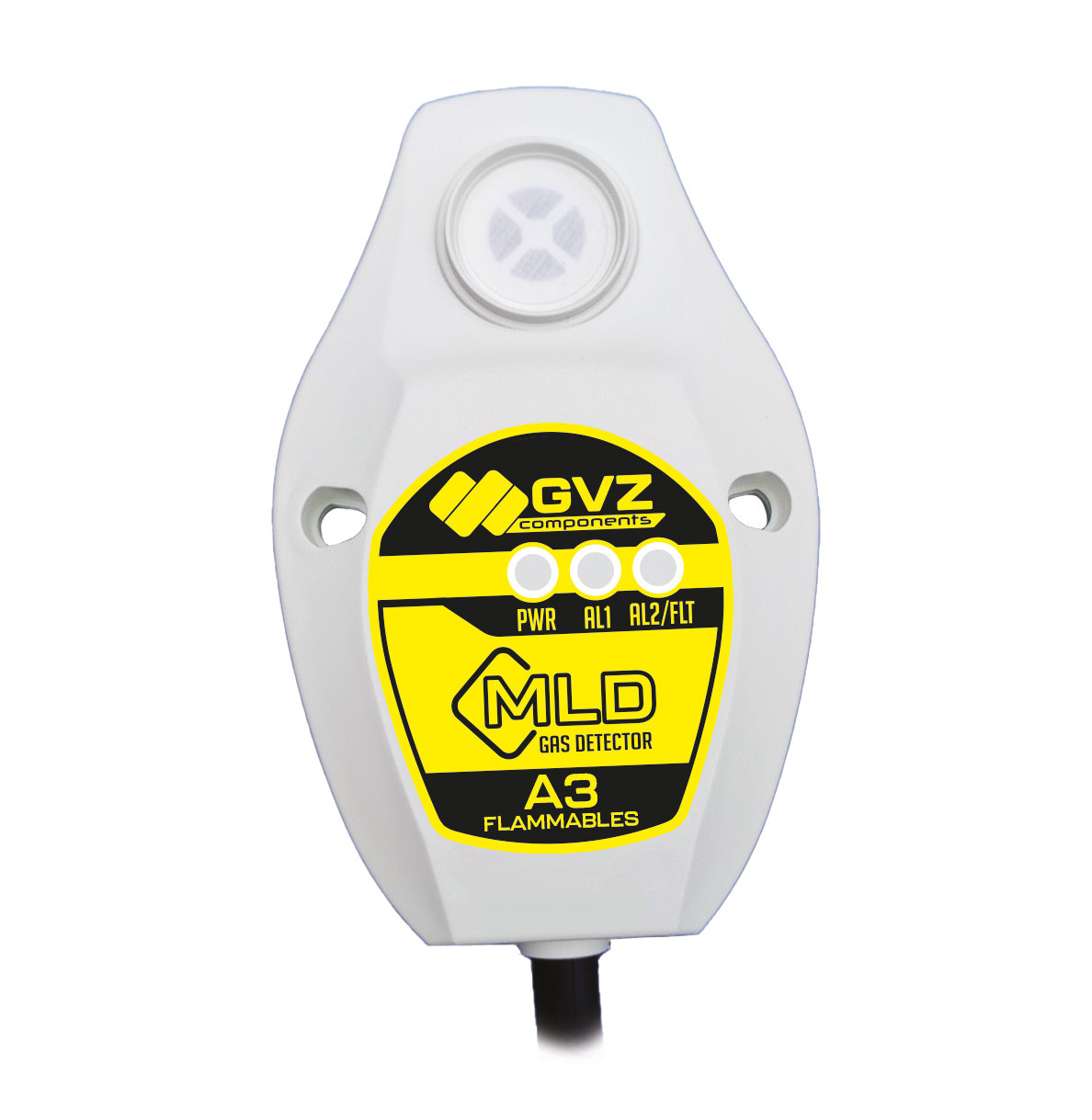
Gas Label
Indicates the gas target of a specific model
Led lights
They report the detector status by color and flashing codes.
- PWR - Power ON/OFF status
- AL1 - Alarm 1 threshold
- AL2/FLT - Alarm 2 threshold / fault

Nose
This is the place where the detector receives air from the surrounding enviroment. The sensor element is placed just below here.

Fixing holes
When coupled with its dedicated bracket, the MLD can be locked in place by matching the correspondend bracket hooks.
Cable
MLD comes with 1,5 or 3 meters cable, without
connector
Applications

- Residential Air Conditioning – all types
- Commercial Air Conditioning
- Industrial Air conditioning
- Data Center cooling
- Server farm cooling
- Hospitals and health care
- Educational Institutions
- Grocery / Food Retail

- Upstream, midstream, and downstream combustible gas detection for safety and compliance monitoring.

- Hydrogen gas detection for battery room safety
- Thermal runaway monitoring.

-
Combustible gas detection for underground mining operations and battery-powered equipment.
Molecular Leakage Detector for flammable gas based on ultimate MPS™ technology.
This flammable gas detector is a unique solution using the latest MPS™ (Molecular Property Spectrometry) technology to indicate the presence of flammable gases providing both a continuous signal proportional to the gas concentration and the activation via relay for alarming once a prefixed (and settable) level is reached.
It combines all the advantages of MPS™ technology as in terms of long lifetime, no field calibration, built-in environmental compensation, no poisoning, wide temperature operating range and durability with a dedicated electronic board for easy interfacing the common control units thanks to the multiple outputs: Modbus, 2x Relays and 2x Analogue Output (ALL IN ONE).
| SENSOR PERFORMANCES | |
| Technology | Molecular Property Spectrometry™ by NevadaNano |
| Gas detected | butane, ethane, hydrogen, isobutane, isobutylene, isopropanol, methane, methyl ethyl ketone, octane, pentane, propane, propylene, toluene, xylene |
| Response Time | <12 sec. |
| Response Time (T90) | <20 sec. |
| Resolution | 0,1% LEL |
| Lifetime | 15+ years |
| List of Detectable gas Based on MPS sensor on board the MLD can detect the following gas with the range and accuracy as indicated below |
||||||
| MLD Gas ref. code | Gas Type (Refrigerant Code) |
Measuring Range | Resolution | ACCURACY | ||
|
UL 60335-2-40 |
ISO 817 /ASHRAE 34 |
ISO 10156 |
||||
| MLD-MN F6 |
Flammables, |
3-100% LEL | 0.1% LEL | -- | -- |
|
|
New gases are under continuous development and they will be added to new MLD versions. |
||||||
| OPERATING FEATURES | |
|
Signals Output |
Gas concentration, Temperature, Humidity, Pressure, Status, Prealarm, Alarm, Fault, Lifetime |
|
Measurament Output |
Digital: Modbus (RS-485) - Analog: 4-20mA - Analog: 0.1-2.9V |
|
Visual Information |
Visual: 3x LEDs (Status / Alarm1 / Alarm2 / Fault) |
|
Supply Voltage |
12-24VDC ±10% |
|
Power Consumption |
Avg. 50mA |
|
Operating Temperature |
-40° to +70°C (12VDC) | -40° to +60°C (24VDC) |
|
Operating Humidity |
0 - 100% RH |
|
Operating Pressure |
80 to 120 kPa |
|
Protection grade |
IP65 |
|
Dimensions MLD-S4 |
13.0 x 8.0 x 4.0 cm |
|
Dimensions MLD-MN |
13.0 x 8.0 x 2.5 cm |
|
Certifications & Approvals |
CE, EMC, Rohs, EN60079-0, EN60079-11, ATEX |
 |
Carbon Footprint: The CO2 equivalent emissions in the production of a single MLD device is 1,588 kg. The carbon footprint of the MLDs is calculated by using the cradle-to-gate LCA (Life Cycle Assessment) method. This means that the system boundary include all greenhouse gas emissions that occur from the input of raw materials (cradle) to the end of the product’s production (gate). |
- Applications
- BrandsGVZ Custom Solutions
- TechnologyMPS™
- TypeFix Detector


