

- NEW !
Gas Leaks monitoring system
-
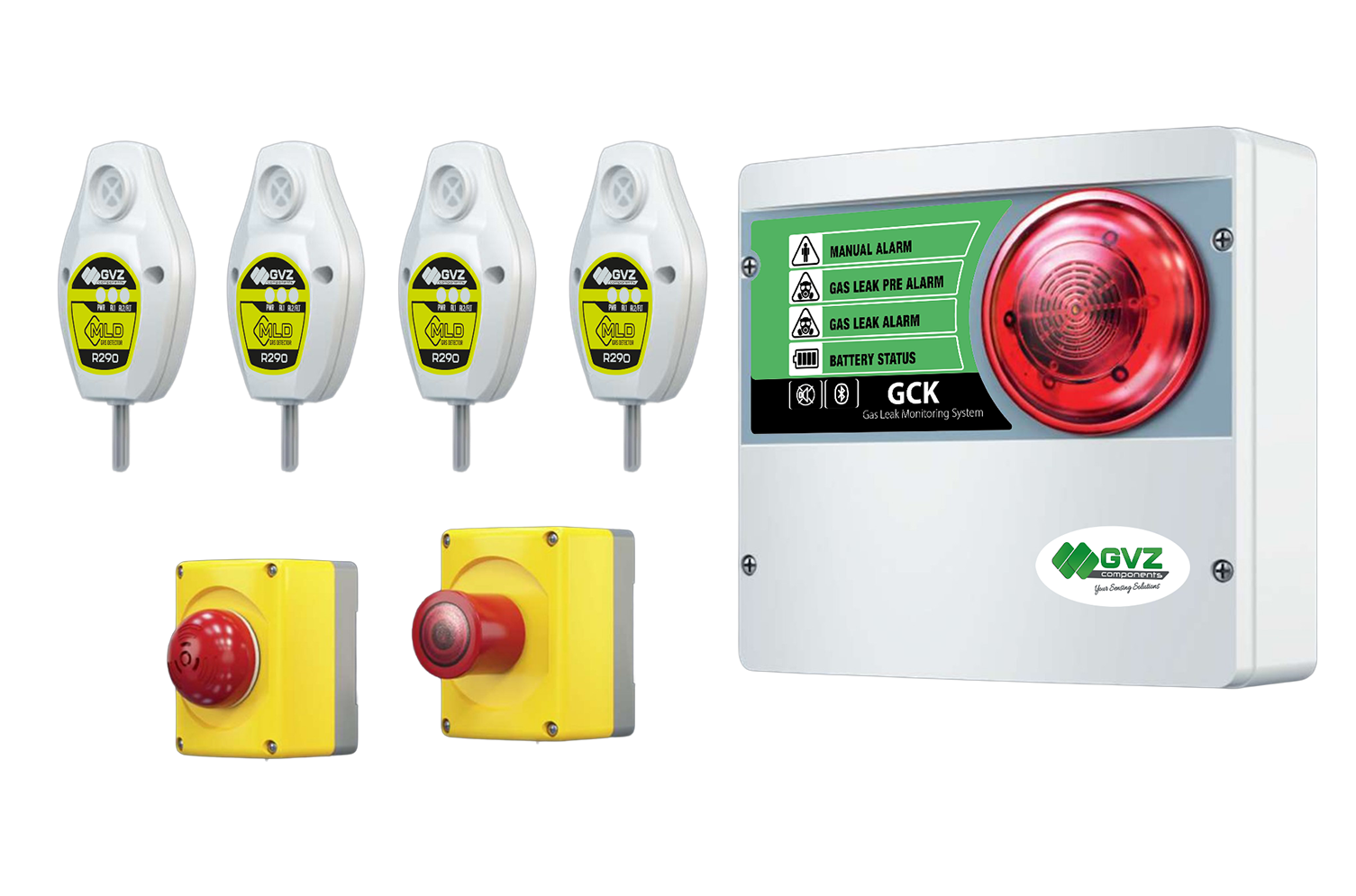
- Complete kit with 1 central unit, emergency pushbutton, alarm bell and up to 4 MLD gas detectors
- Visual and audible alarm control unit
- Rechargeable backup battery
- Illuminated pushbutton for manual alarm
-
- Test chambers for HVAC units using flammable refrigerants
- Production lines and gas charging stations for HVAC units
- Laboratories for testing with flammable gases and technical rooms
- Complex HVAC-R units requiring multiple gas leak detection points
- Engine rooms in marine applications
Description
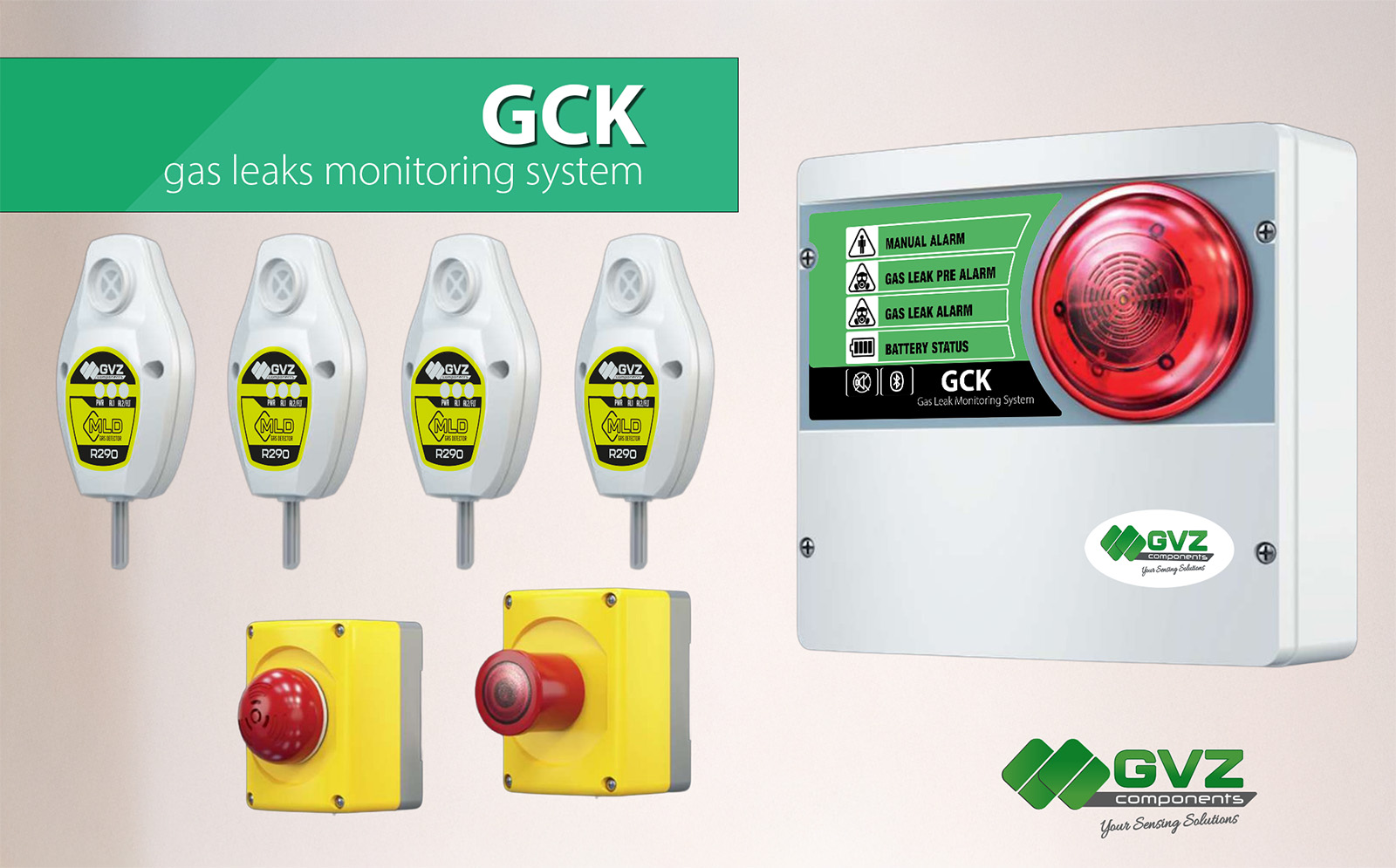
Complete solution for gas leak monitoring: Gas Control Kit
The Gas Leak Monitoring Kit consists of one or more (up to 4) MLD (Molecular Leakage Detector) gas detectors and a control unit equipped with audible and visual alarms, backup battery, illuminated emergency pushbutton for manual alarm activation, and a secondary visual/acoustic siren for remote signaling.
The kit enables pre-alarm and gas leak alarm signaling for a wide range of gases (A2L and A3 refrigerants, methane, propane, hydrogen, etc.).
The system is designed to operate even in the event of a temporary power outage, thanks to the backup battery integrated into the main control unit.
In addition to visual and audible alarms, the control unit provides two dry-contact relays and a dedicated Modbus communication line for integration with third-party systems.
-
Visual and audible alarm control unit, compliant with UNI EN 378-1, featuring an integrated siren and flashing light for gas leak alarm signaling, as well as a backup battery for blackout conditions.
The unit includes dual relays providing dry contacts (closed when alarm is active) that can be used to activate remote alarm signaling.
It also features dual RS-485 serial lines with Modbus RTU protocol: one dedicated to gas detector management and one available for integration with third-party systems. -
Bluetooth programming via dedicated mobile app
-
Rechargeable backup battery with battery status and efficiency monitoring
-
Alarm control unit equipped with a mute button to silence gas alarms during periodic functional testing
-
MLD gas leak detectors to be installed at the required locations, with separate pre-alarm and alarm signaling. Up to 4 gas sensors can be connected in series via Modbus
-
Emergency pushbutton station to be installed in a location easily accessible to the operator. It features an illuminated pushbutton for manual alarm.
LED illumination is permanent to ensure visibility even in dark conditions. Up to 4 pushbuttons can be connected -
Secondary visual and audible alarm for gas leak signaling, to be installed in a location separate from the control unit (optional)
- GAS TARGET - Refrigerants: R290 – R50 – R170 – R600 – R600a – R601 -R1270 – R32 – R454A - R454B - R454C – R1234ze
- Flammables: butane, ethane, hydrogen, isobutane, isobutylene, isopropanol, methane, methyl ethyl ketone, octane, pentane, propane, propylene, toluene, xylene
| Control Unit Parameter | Specification |
| Dimensions | 203 × 193 × 79 mm |
| Weight | 3 kg |
| Power supply | 230 VAC, 50/60 Hz |
| Max. power consumption (main supply) | 10 VA |
| Backup battery | 12 VDC Ni-MH, 1300 mAh |
| Full recharge time | 10 h |
| Operating autonomy | 10 h (with fully charged battery) |
| Operating temperature | -5 ÷ +45 °C |
| Acoustic characteristics | Type: piezoelectric – Sound level: 90 dB @ 1 m |
| Visual indication | Flashing red LED, 12 VDC |
| Alarm / AUX relays | No. 2 – 5 A AC1 (SPDT) |
| Supervision | TeleNet / Modbus RTU |
| Serial communication | Modbus RTU |
| Bluetooth | BLE with myPego app |
| Protection rating | IP65 |
- Filter by Refrigerant
- R50 (Methane)
- R170 (Ethane)
- R290 (Propane)
- R600 (Butane)
- R600a (Isobutane)
- R601(Pentane)
- R1270 (Propylene)
- R1150 (Ethylene)
- Applications
- BrandsGVZ Custom Solutions
- TechnologyMPS™
- TypeMonitoring System


