


Next-Generation MEMS Multi-Gas Sensing
Sensing of gases is a critical function but the technology hasn’t changed in decades. Now the brand-new type of sensor from NevadaNano is a game changer for the market.
MOLECULAR PROPERTY SPECTROMETER
NevadaNano calls their sensor, a MEMS-based device, the Molecular Property Spectrometer™ (MPS™).
The MPS Flammable Gas Sensor can detect and identify the concentrations of 12 of the most common combustible gases, including hydrogen; the MPS Methane Gas Sensor is designed to monitor methane leaks for the oil and gas industries; the MPS Refrigerant Gas Sensor detects mildly flammable low global warming refrigerants— all based on the same technology. According to Rogers (Director of Engineering @NevadaNano), their sensor is far more accurate and reliable than the traditional Pellistor (catalytic bead sensor) and Nondispersive Infrared Sensor (NDIR). Most traditional sensors have a coating that excites some sort of chemical reaction. The problem is that over time, the sensing sites that enable the reaction can be ruined. The MPS, however, is an inert silicon-based surface, which doesn’t require any chemical reaction. It heats up, measures the thermodynamic properties of the air, and then cools back off again, so it can last for 10 years or more without any calibrating, according to Rogers.
IDENTIFYING A GAS
The MPS is built into about an inch-sized package. Air to be tested enters through the mesh screen at the top and impinges upon a suspended, tethered micro hotplate, which is the same diameter as a human hair — 100 microns across. The hotplate can be heated up to hundreds of degrees Celsius. The source of the heat is a Joule heater, in which an electric current is fed through a resistive element as shown in the inset of Figure 1. The current comes in on one of the tethers, swirls around and comes out on that trace. “We can measure the resistance of the hotplate, which gives us its temperature and also the power it took to reach that temperature,” said Rogers. The relationship between the temperature of the plate and the power required to reach that temperature is a function of the thermal conductivity of the air. When the air has gases in it, its thermal properties change. For example, if methane is present in the air and the hotplate is heated, since the methane is more thermally conductive than the air, it takes more power to keep the hotplate at the right temperature than it does when methane is not present.
Key to its unique properties, the MPS is a MEMS device, produced similarly to silicon chips: in a foundry; and because it’s a MEMS device it requires very little power to operate. “There’s never been a combustible sensor before that can tell you the class of gas you’re detecting. When we make a detection, we also provide a classification. For example, the sensor reports the concentration present and that it’s hydrogen, or a medium gas like pentane, or a hydrogen mixture,” said Rogers. “Traditional gas sensors have never had the ability to do classification. That’s what makes us so accurate: because we can adjust our calibration for whatever gas is there.”
CONCENTRATION
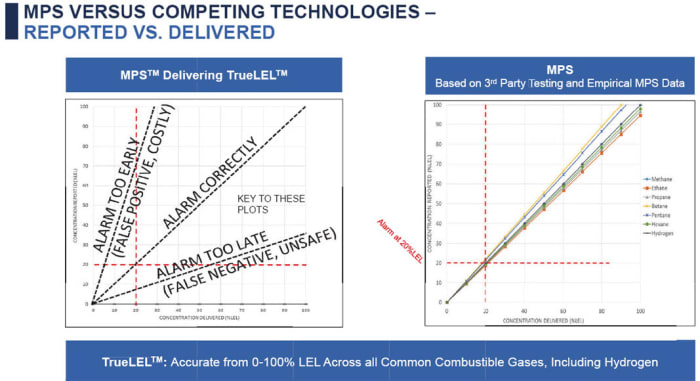
The unit of concentration that matters is the Lower Explosive Limit (LEL), which is the lowest concentration (by percentage volume) of a gas in air that is capable of producing a flash of fire in the presence of an ignition source. Since users want to know how close they are to 50% of the LEL, the ability to identify which gas is present is important because the LEL for each gas is different.
ALGORITHMS
“We’re good at two things,” said Rogers. “One is building the hotplate sensor, which took years of development. And two, learning how to talk to that hotplate.” The basic device is quite simple — just a heated resistor and a temperature measurement. How that information is used is key to the sensor’s functioning. The data coming from the hotplate along with data coming from an environmental sensor that measures temperature, pressure, and humidity are used to obtain the readings. “Every two seconds we take the data from the hotplate, we take the data from the environmental sensor and we run a bunch of algorithms that have taken us 15 years to develop and out comes: ‘it’s this gas, it’s this concentration,’ and that’s the trick,” said Rogers.
Taking the same data but changing the algorithms has enabled NevadaNano to develop dozens of products that are based on software changes. For example, there’s a new breed of refrigerants that are low global warming. But many of these new refrigerants, used in air conditioning units and refrigerators, etc., are flammable. Therefore, all residential air conditioners are going to require flammability sensors to prevent an unsafe condition. Based on the thermodynamic properties of those refrigerant molecules NevadaNano was able to come up with a product uniquely suited to that particular species of gas or multiple, just by making a software change. So, within about a month they had a new Alpha product and started taking it out and showing it to people.
CALIBRATION
I asked Rogers if they needed to calibrate each sensor for a particular gas. He replied that it depends upon which gas needs to be detected. For the standard flammable gases, they use methane as the calibrant gas at the factory. “Once we’ve shown the sensor methane, we don’t have to then calibrate it to hydrogen, butane, propane — it intuitively senses all the other gases as well.” So, for example, they don’t necessarily have to use hydrogen at the factory to calibrate a hydrogen-specific sensor.
APPLICATIONS
I then asked Rogers about typical applications. “We’re just the sensor — we’re that that little bucket-shaped device that gets plugged into a detector system. For example, if you were to go to a refinery today and look around on the walls, you would see many dozens of devices that kind of look like utility power meters.” They have multiple sensors plugged into them, probably including a hydrogen sulfide sensor, an oxygen sensor, a carbon monoxide sensor, and a flammable gas sensor such as the MPS.
Firemen and other first responders running into a building typically wear what’s called a four-gas sensor — a little cell phone-sized device that sort of sits on their shoulder and has four gas sensors in It, including an MPS.
SUMMING IT UP
According to Rogers, the MPS is the most innovative technology for gas detection in over 30 years. It overcomes the shortcomings of existing technologies; it is stable across broad operating ranges, including rapid temperature and humidity changes; it is accurate for a list of common flammable gases (including hydrogen). Furthermore, the MPS can be used for environments with multiple or unknown gases present and is intrinsically safe, robust, and immune to poisoning.
This article was written by Ed Brown, Editor of Sensor Technology. For more information, visit here


