


Merit Sensor Application Note AN104
The LP Series pressure sensor is a surface-mount device that is easy to solder to a PC board and connect to standard tubing.
It can measure pressure ranges as low as 0 to 1 inH2O (0 to 250 Pa) with resolution better than 0.001 inH2O (<0.1 Pa). It performs with excellent linearity, hysteresis, and stability.
The LP Series was designed to measure differential or gauge (also spelled gage) pressure, depending on the application. It contains two pressure ports to which tubing can be connected, one tube directing pressure to the topside of the MEMS sensing element and the other tube directing pressure to the backside of the MEMS sensing element.
Differential vs. Gauge Pressure
Differential pressure is determined by measuring pressure at two distinct points (often labeled P1 and P2) and determining the difference between the two measurements. Gauge pressure is determined by measuring pressure at one distinct point and referencing that measurement against the ambient air pressure.
It is worth noting that absolute pressure is similar to gauge pressure with the exception that the pressure source for absolute is referenced against a perfect, absolute vacuum (created by a glass constraint on the bottom of the MEMS sensing element), rather than ambient air pressure.
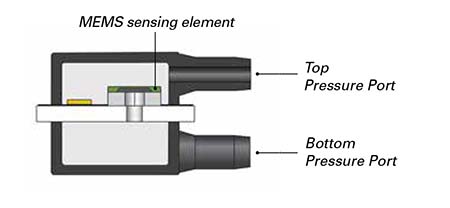
For the measurement of differential pressure, tubing must be connected to both pressure ports of the LP Series. If the calibrated differential pressure is symmetrical (±250 Pa, ±1 psi, etc.), then it is not critical which pressure port of the LP Series is connected to P1 or P2. In either case the differential pressure value will be the same. In the case of a custom, non-symmetrical differential pressure calibration (-500 to +1000 Pa, -5 to +10 psi, etc.), then it’s important to understand how each port was referenced during calibration.
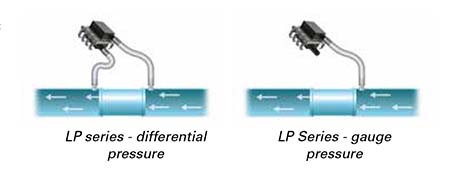
For the measurement of gauge pressure, where there is only one pressure source, the positive pressure is applied to the top pressure port of the LP Series. In this configuration pressure from the application is applied to the topside of the MEMS sensing element, and the backside of the MEMS sensing element is vented to, or gauged against, ambient pressure by way of the open pressure port. It is critical that the bottom pressure port be the open/vented port because when the MEMS sensing element is calibrated for gauge pressure, it is done so with pressure applied to the topside of the MEMS sensing element.


